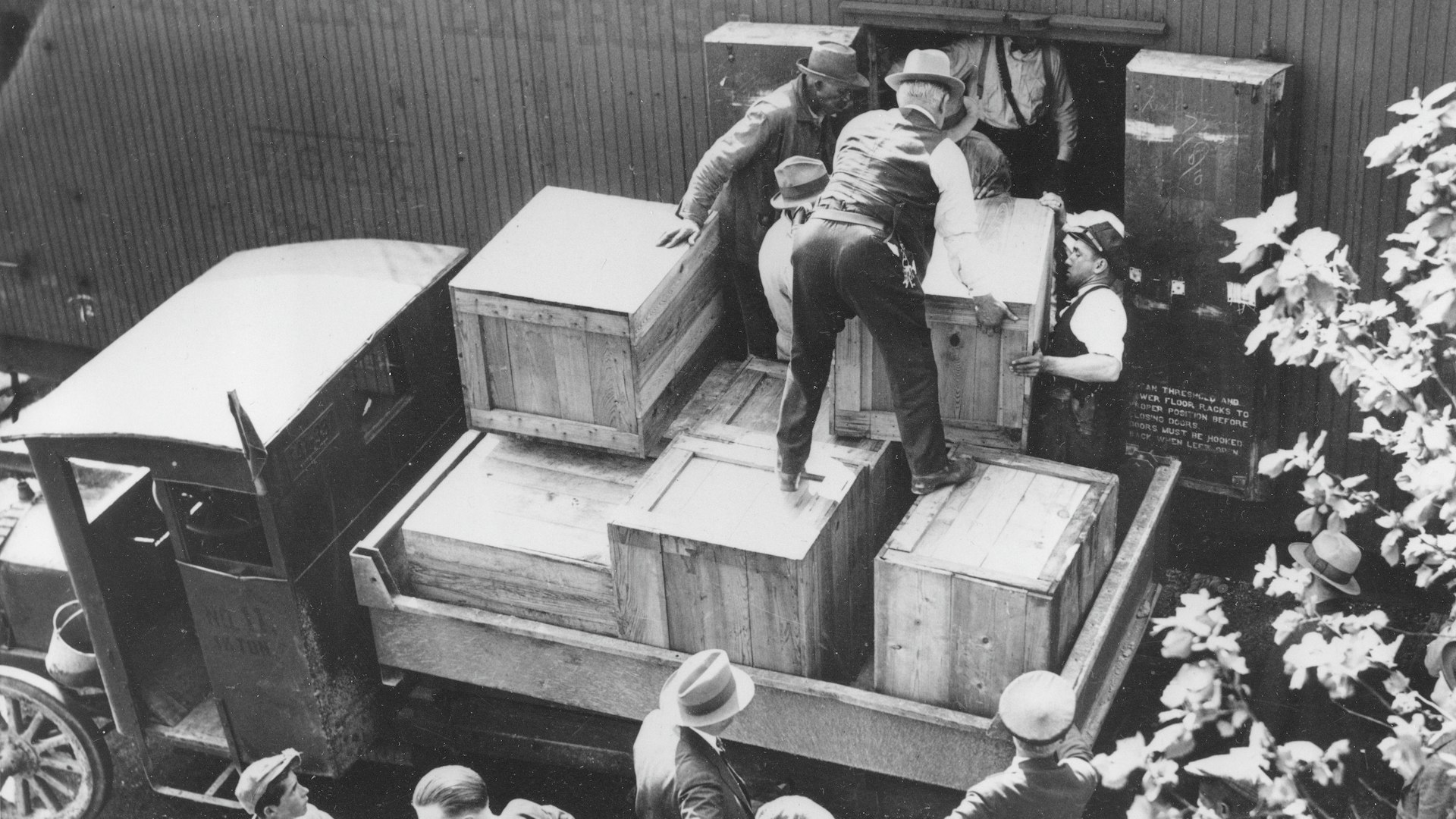
Between 1920 and 1933, the United States banned alcohol. Canada briefly followed suit. Quebec adopted a prohibition that lasted only a few weeks in 1919, before legalizing alcohol again in 1921.
What follows is not a romantic cultural resistance. It is a parallel economy and a pragmatic tolerance toward a law perceived as foreign.
A Porous Border
Border regions such as Témiscouata and the Eastern Townships became transit zones. Alfred Lévesque, known as the “bootlegger of Témiscouata,” ran a network employing around 800 people and using nearly 500 cars to transport alcohol into the United States.
In Abercorn, just steps from the U.S. border, five hotels were operating during the 1920s. The Palace of Sin straddled the border between Glen Sutton and East Richford, with two bars on the ground floor: one in Quebec, the other in Vermont.
A City That Never Sleeps
Starting in the 1920s, Montreal became the “Paris of the North.” Jazz musicians from New York and Chicago, such as Count Basie and Duke Ellington, came to perform in the Red Light district, where alcohol flowed freely.
In 1924, Samuel Bronfman opened a distillery in LaSalle. The Bronfmans sold alcohol to cities in the northern United States from the Montreal area, where production remained legal.
A Paradoxical Legacy
In 1921, the Commission des liqueurs was created, the direct predecessor of today’s SAQ. Its mandate was to generate postwar revenue, control sales to reassure temperance groups, and combat smuggling linked to American prohibition.
A pragmatic compromise for a turbulent era.
A century later, the model still stands: a state monopoly, strict controls, high taxation. Today, 72 percent of the price of a bottle goes to the state through taxes, margins, and excise duties. A structure born to regulate a problem that disappeared long ago, but which has become a fiscal machine.
Meanwhile, the United States now has more than 3,000 distilleries. The market has diversified, multiplied, reinvented itself.
Here, only a handful of us navigate a rigid system, where every new product waits months before reaching a shelf.
What This Says About Us
Alcohol is the most socially accepted psychoactive substance in Quebec. It is celebrated and treated as a marker of cultural identity. We distill it, age it, and build stories around it.
But we cannot sell it directly. We must go through a single network, where innovation waits for committee approval.
This is not prudence. It is institutional inertia.
Quebec never truly believed in prohibition. But it never really questioned the system that was born from it.
An Open Question
Bootleggers have become folkloric figures. We like to remember the time when Quebec circumvented rules imposed from elsewhere.
But today, the rules are ours. And they freeze a market that could breathe.
Perhaps, a century later, it is time to ask whether the control inherited from prohibition still serves a purpose — or if it simply protects a structure that has become its own raison d’être.